

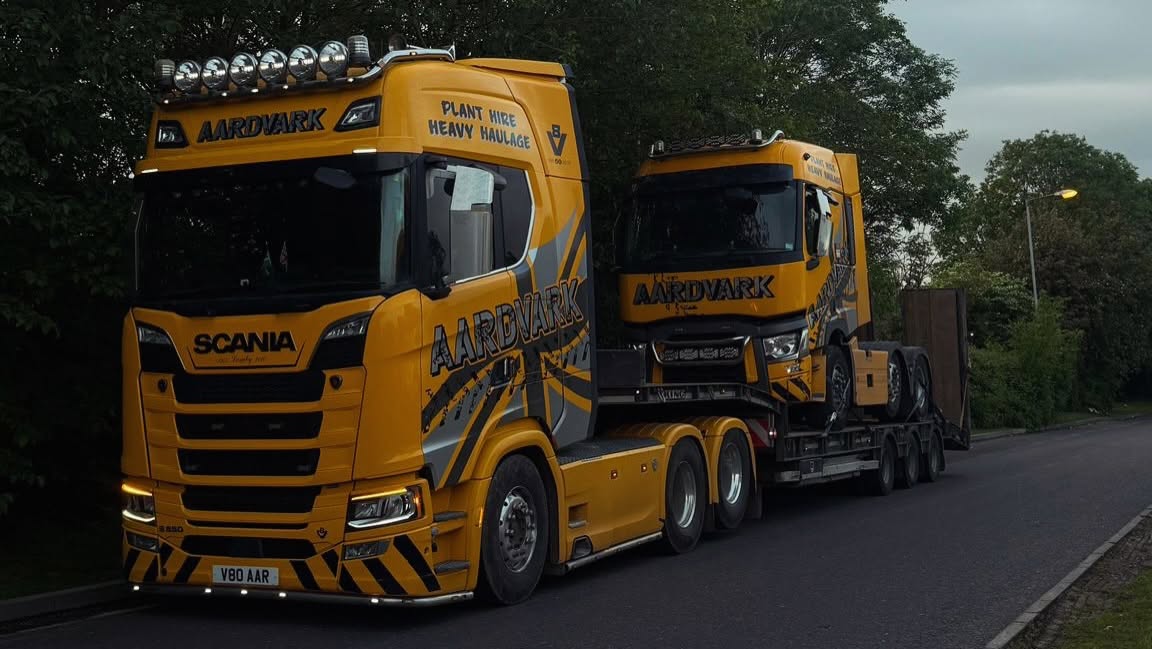
There’s something satisfying about a yellow rigid loaded up on a yellow low loader. Both wearing the Aardvark colours, both doing exactly what they were built for. It’s not a coincidence that so much of our fleet runs in the same livery. Consistency across the fleet is part of what makes the operation recognisable on the road, and it’s part of how customers know it’s us pulling into their site.
Plant transport on a rigid low loader covers a huge range of jobs. Rigid low loaders are particularly useful for shorter distance work and for accessing sites where an artic would struggle. The overall length is shorter, the turning circle is tighter, and you can get into places that a tractor and trailer combination simply couldn’t reach without a lot of shunting and swearing. For plant deliveries to tight yards, town centre construction sites, or rural jobs down narrow lanes, a rigid low loader often earns its keep several times over on a single job.
The trade-off is capacity. A rigid low loader doesn’t carry as much as an artic low loader, so for longer distance runs with heavier machines an artic setup usually makes more sense. That’s why we run both. Matching the right vehicle to the right job is one of the fundamentals of running a proper heavy haulage operation. Sending the wrong truck adds cost, adds time, and sometimes means the job doesn’t get done at all.
Plant transport itself is a specialist area. You’re moving expensive, heavy, oddly shaped machines that need to be loaded, secured, and delivered without damage. Excavators, rollers, dumpers, telehandlers, and specialist attachments all have their own quirks when it comes to loading. Track machines need proper ramps and careful positioning to avoid stressing the tracks or damaging the trailer deck. Wheeled plant needs to be strapped in a way that accounts for suspension movement. Anything with hydraulic attachments needs those attachments stowed properly for transit. Get any of it wrong and you can turn a routine delivery into an insurance claim.
Load securing is the bit that separates proper operators from people just running a truck. UK regulations on load securing for plant transport are strict, and they’re strict for a reason. A poorly secured machine that shifts in transit becomes a serious hazard on the road, and the driver, the operator, and the transport company all carry responsibility if something goes wrong. Doing it properly means using the right number of chains and straps, running them through proper lashing points, tensioning correctly, and checking during the journey. It takes longer than throwing a couple of straps over the top, but it’s the only way it should be done.
The Aardvark yellow is more than just paint. It’s part of a fleet standard that runs through the whole operation. Well-maintained vehicles, clean livery, professional presentation on site. Customers notice this stuff. When one of our trucks pulls up, it’s clear who they’re dealing with and what standard they can expect. That consistency is what turns one-off jobs into repeat customers.
Yellow on yellow just happens to look good in the photos too.
If you want more information regarding plant transport, low loader hire, or moving your machines with Aardvark, contact us on 01392 832124.