

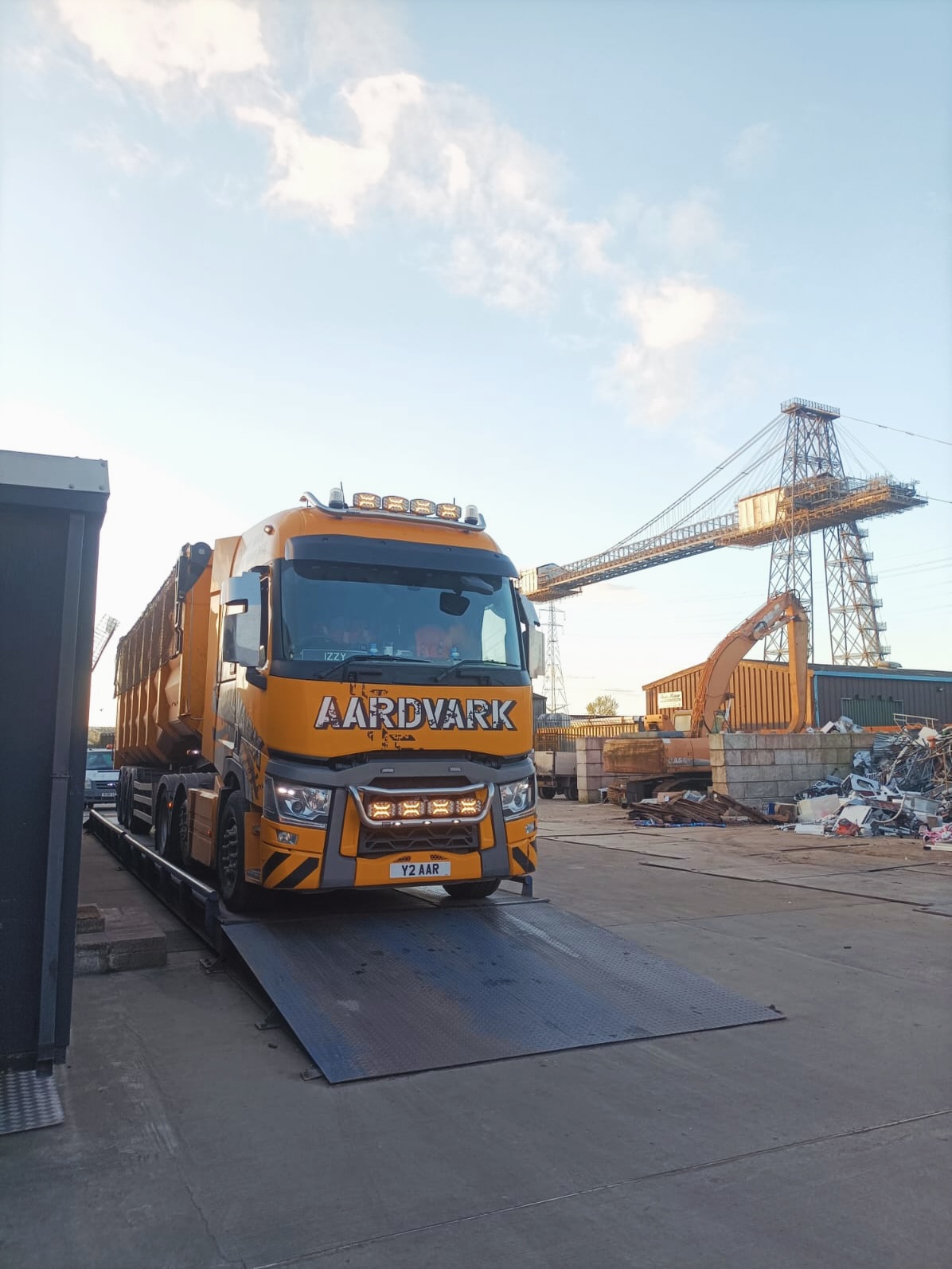
There’s a running joke around the yard — wherever scrap metal is being moved in the South West, you’ll usually spot one of our yellow lorries somewhere nearby. This week’s run took us down to a scrap site under the shadow of the Newport Transporter Bridge, loading up and heading back out. It’s bread and butter work for us, but it’s worth talking about because scrap haulage isn’t quite as straightforward as it might look from the outside.
Scrap metal transport is one of those jobs that punishes corner-cutting. The loads are heavy, often awkwardly shaped, and the operating environment — scrap yards, recycling centres, port facilities — tends to be tight, dusty, and full of moving plant. Get the wrong truck and trailer combination, or send a driver who doesn’t know what they’re doing, and you’ll spend half the day waiting to get loaded, the other half worrying about whether the load is going to shift on the way home.
The trailer in the photos is a bulk tipper — high-sided, mesh-topped, built for moving loose loads like scrap, aggregates, and recycling material at maximum capacity. The mesh net across the top isn’t decorative; it’s there to stop bits flying off in transit and to keep the load compliant with regulations on load security. Anything that could blow out of an open-topped trailer at 56mph becomes a serious hazard for the vehicles behind you, and the rules around securing this kind of load are tight and getting tighter.
Capacity matters with scrap work. Density varies hugely depending on what you’re carrying — a load of light cuttings takes up more cubic metres per tonne than a load of heavy plate steel, so you need to size the trailer to the material. Bulk tippers like the one we’re running here are sized to take a proper payload of low-density scrap without going over weight, which means fewer trips, lower cost per tonne moved, and less time spent on the road. For scrap dealers and recycling operators, that efficiency feeds straight through to their margins.
Then there’s the tipping side of it. A lot of scrap haulage involves discharging directly into yards, processing lines, or onto ships at port — and that means you need a tipper that can lift safely on uneven ground without going over. Drivers have to know how to read the surface, position the truck properly, and watch the trailer as it lifts. Tipping a fully loaded trailer is one of the higher-risk parts of the job, and experience genuinely counts for something here.
Scrap routes also tend to be repeat work. Yards process material on a continuous cycle, and the operators who keep their flow moving smoothly are the ones with reliable haulage in place. Turning up when you said you would, getting loaded and away quickly, and getting the material to its destination in good order — that’s what builds the long-term relationships in this industry. It’s not glamorous, but it’s how the work keeps coming.
There’s also the broader picture worth mentioning. Scrap metal recycling is a properly significant part of the UK economy, and the haulage side of it is what makes the whole loop work. Material gets collected from sites, transported to processors, sorted, baled or shredded, and then moved on to mills or export terminals to be turned back into new product. Every step of that chain depends on trucks and drivers who can shift the material reliably and at the right cost. Without proper haulage, the recycling industry simply doesn’t function.
For anyone running a scrap yard, recycling operation, or industrial site that generates regular volumes of metal, having the right haulage partner in place makes a real difference. Bulk capacity, the right trailer types, drivers who know the yards, and the kit to handle whatever the material throws at you — that’s the package that actually works. Anything less and you’re either paying too much per tonne or spending too much time chasing trucks.
Where there’s scrap, there’s usually a yellow lorry. That’s not by accident — it’s because the work keeps coming back to operators who know how to do it properly.
If you want more information regarding scrap metal haulage, bulk tipper transport, or recycling logistics, contact Aardvark on 01392 832124.